Thickness Dependence
When the thickness of a cavity layer is continuously tuned, the cavity photon mode shifts in frequency because the round-trip phase condition changes. If the cavity contains a dispersive absorber (as in the polariton dispersion example), the photon mode sweeps through the molecular resonance and the resulting heatmap traces the avoided-crossing anticrossing as a function of layer thickness rather than angle. sweep_thickness automates this scan: it replaces the thickness of one layer index across a range while holding everything else fixed.
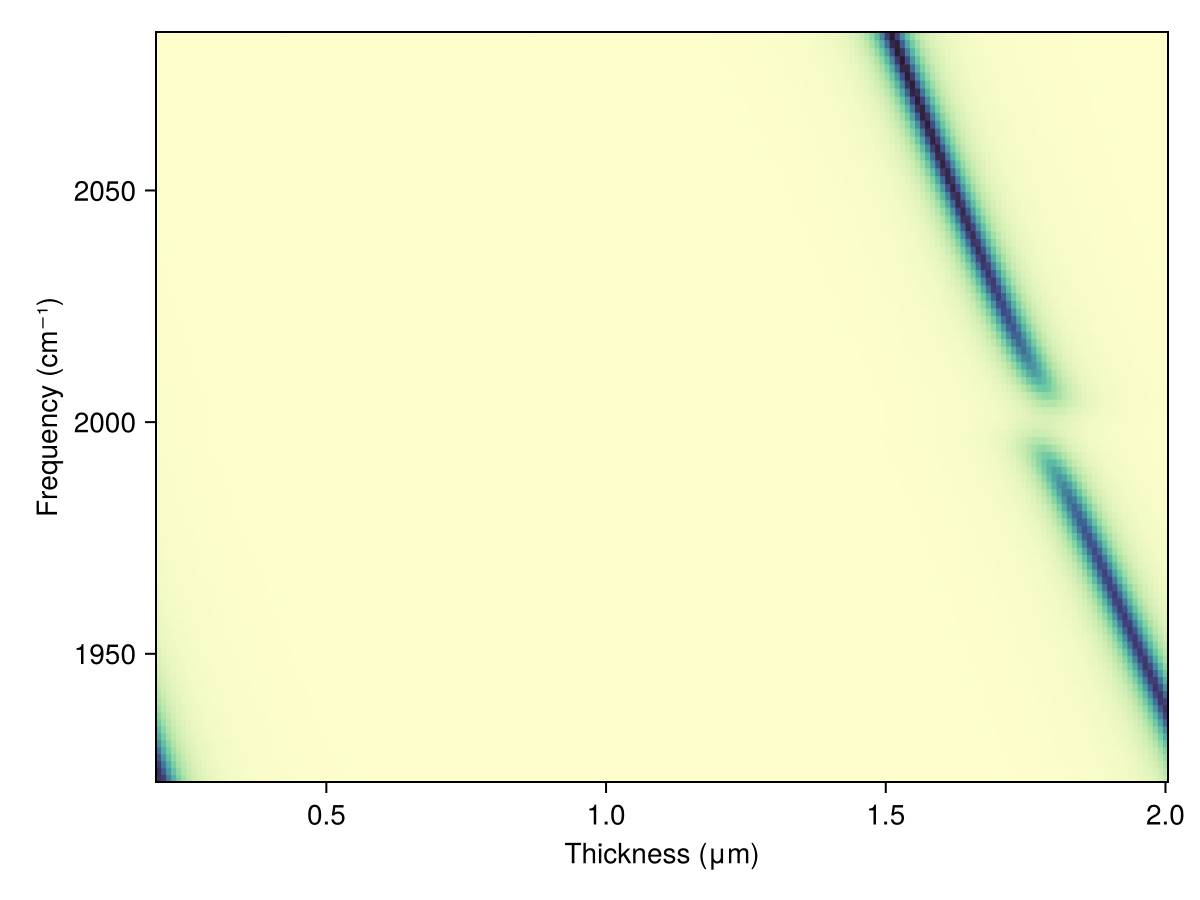
The key construction:
# Dispersive absorber built via Lorentz → (n, k) → Layer(λs, n, k, t)
# (see the polariton dispersion example for this construction)
absorber = Layer(λs, n_medium, k_medium, t_cav)

nperiods = 4
unit = [tio2, sio2]
layers = [air, repeat(unit, nperiods)..., absorber, repeat(reverse(unit), nperiods)..., air]

# Sweep the absorber layer (index 10 in this stack) over a range of thicknesses
thicknesses = range(0.2, 2.0, length = 200)
res = sweep_thickness(λs, thicknesses, layers, 10)
The full runnable script is examples/thickness_dependence.jl.